

Investing in and immigrating to a new country comes with multiple challenges, and one of the most important is understanding how the education system works, especially if you have school-age children. This article aims to provide a clear and detailed overview of the education system in the United States, addressing the most common concerns and questions that arise for our clients, investors, parents.
If you are looking for clarity on how to prepare your children for this new environment, don’t miss the video we have prepared together with GRacademic. There we address in depth topics such as school adaptation, academic opportunities and the key aspects you should consider when planning your move. Press play on the video and start clearing your doubts:
Education Levels in the United States
The educational system in the United States is divided into several levels, each with specific characteristics and objectives that contribute to the integral development of students.
Pre-school education
Preschool education in the United States spans from birth to age 5. Although it is not mandatory, many parents opt for it to promote the
Elementary School
Primary education, which runs from 1st to 5th grade, is aimed at children aged 6 to 11 years. During this period, students gain foundational knowledge in reading, writing, math, and science, as well as exploring subjects such as art, music, and physical education. Primary education lays the foundation for advanced learning and the development of essential life skills.
Secondary Education (Middle School and High School)
Secondary education is divided into two stages: Middle School, which covers grades 6-8 (ages 11-14), and High School, which runs from grades 9-12 (ages 14-18). In Middle School, students delve deeper into academic subjects and begin to explore specific interests. In high school, they prepare for higher education or the world of work, with options including advanced courses, vocational programs, and extracurricular activities.
College and Tuition
Postsecondary education in the United States includes a variety of options, from research universities to community colleges and technical schools.
Types of Education in the United States
In the United States, as in many parts of the world, there are both public and private educational centers, below we analyze their differences:
Public education vs. Private education
Public schools in the United States are free and funded by the government, with their allocation usually based on residence. The state you live in plays a crucial role in public school allocation.
Some states with highly rated education systems include Massachusetts, Connecticut , and New Jersey. Families often choose these states because of the quality of their schools and educational programs.
On the other hand, private schools in the United States, funded by tuition and donations, may have admission requirements and offer different educational programs. These institutions seek to create more exclusive academic environments. Educational programs in private schools often incorporate innovative pedagogical approaches, cutting-edge technology, and more individualized attention to each student’s needs.
5 facts about the education system in the United States
1. Diversity of educational options
In U.S. public schools, students have access to a wide range of educational options, reflecting a flexible and adaptive system. The majority (

2. Investment in education
The average K-12 public education spending per student during the 2022-2023 school year was $15,632, evidencing the United States’ substantial commitment to education. By fiscal year 2024, K-12 public schools are projected to spend an average of
Importantly, these values can vary significantly between states and school districts, depending on factors such as local funding, state policies, and the specific needs of each educational community.
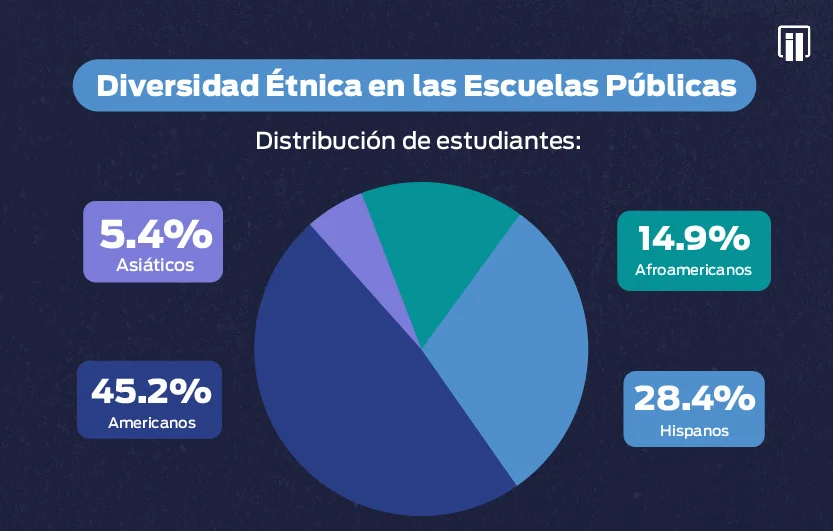
3. Ethnic diversity in public schools
In 2021, the ethnic composition in public schools reflected the nation’s rich cultural diversity. American students made up
4. High School Graduation Rates
With an 87% graduation rate nationally during the 2019-2020 school year, the United States demonstrates its effectiveness in retaining and graduating its students.
Although complete data for the 2022-2023 school year is not yet available, preliminary reports from some school districts indicate increases in their graduation rates. For example, the Charlotte School District in North Carolina reported an increase in its overall graduation rate, going from 82.6% to 84%.
These high graduation rates are a testament to the success of the education system in providing a quality education and ongoing support to students throughout their academic career.
5. Advances in academic proficiency
Compared to several Latin American countries, progress in academic proficiency in the United States shows encouraging figures. In 2022, performance in math and reading for eighth graders was 26.5% and 30.8%, respectively. Despite areas for improvement, these figures highlight continued efforts to improve academic performance in key subjects. In addition, it underscores the importance of innovative and effective educational strategies for the development of critical skills in students.
When considering the decision to immigrate, these statistics can be a motivating factor. This picture of the education system in the United States illustrates a rich and diverse learning environment, with heavy investment in education and a commitment to inclusion and quality. For migrant families and other stakeholders, this system offers multiple pathways to educational and personal success. Its approach prepares students to confidently face the challenges of today’s world.
Although Interlink FBC does not offer consulting services in this area, we recognize the importance of providing information that allows informed decisions to be made. We hope we’ve helped clarify America’s education landscape for you.

